


Growing up, football was my escape from the real world, especially when I first migrated to Canada at the age of ten. Whether it was kicking a ball around with friends or watching matches during odd hours on the weekend, football was a way to build community and learn about the world around me.
When Canada was selected to co-host the Men’s World Cup in 2026, I was elated. But as the years passed and I learned more about the intersections between politics, human rights and football, the joy the sport brought me has slowly faded away.
Modern-day football has increasingly become a vehicle to advance capitalist and political interests, as investigations have revealed how tournament hosting rights are rigged to conceal human rights violations and authoritarian regimes purchase football clubs.
The ‘Beautiful Game’ reached the depths of its ugliness during the last two years as footballing authorities have failed to act on Israel’s ongoing genocide of Palestinians in Gaza. Yet while the powerholders have remained silent and complicit, fans around the world have demonstrated immense levels of solidarity with Palestinians.
The hypocrisy and double standards of football
To better understand the politics, repression and resistance in the football world, I speak with Leyla Hamed, a world-renowned sports journalist and sports law expert. Leyla’s reporting has closely followed the impacts of the genocide in Gaza on the politics of football across the globe. She shares her frustration with the inaction and silence by football’s powerholders during the last two years: “When the genocide in Gaza began, I naively expected at least a minimal response. But instead, we got silence from sporting bodies, federations, and most clubs and footballers, as if Palestinian lives don’t exist in the world of football.”
“FIFA cannot solve geopolitical problems, but it can and must promote football around the world by harnessing its unifying, educational, cultural and humanitarian values,” said FIFA President Gianni Infantino in early October. Yet such a statement is deeply hypocritical considering FIFA and UEFA suspended Russian teams from participating in all football competitions, at both the club and national level, within just four days of Russia’s invasion of Ukraine in February 2022.
More recently, in May of last year, the Palestinian Football Association (PFA) introduced a motion calling on FIFA to suspend Israel from all football competitions.
The motion by the PFA underlined the mass destruction of sport in Palestine, including the killing of over 400 Palestinian footballers by Israel since October 2023. Some have referred to this phenomenon as athleticide: “a modality of genocide designed to undermine and erase a people’s identity through the destruction of one of their most popular and visible forms of cultural expression.” Israeli airstrikes have wiped out youth teams, destroyed over 300 sports facilities such as stadiums and training grounds, and even attacked the PFA headquarters multiple times.
In contrast to the swift response against Russia, the PFA motion’s clear demand for consistency and accountability has only been met with delay and silence. This inaction and complicity must be contextualised.
Despite the extensive evidence of Israel violating FIFA’s own statutes – which prohibit discrimination, demand the protection of players, and ban clubs from playing in illegal settlements – FIFA tasked two committees to investigate the PFA’s motion. Infantino explained that “the FIFA Council has implemented due diligence on this very sensitive manner and, based on a thorough assessment, [they] have followed the advice of the independent experts.”
Leyla disagrees with this characterisation, highlighting the inconsistency of the organisation’s response. “It’s just a bureaucratic smokescreen designed to buy time,” she explains. “It’s a damning indictment of who FIFA sees as worthy of protection, and who it is willing to sacrifice to maintain political comfort.”
States have historically used football as a geopolitical tool: Mussolini utilised the 1934 Men’s World Cup to advance his fascist agenda, Argentina’s military junta masked its bloody dictatorship through the 1978 Men’s World Cup, and today, Saudi Arabia leverages football to cultivate soft power. These examples of utilising sports to conceal human rights abuses and violations are known as “sportswashing,” which can be defined as the use of sport to “improve the reputation of an authoritarian regime, nation-state or organisation, or distract from negative actions such as poor human rights records.”
“Football isn’t apolitical. It’s just selectively political,” asserts Leyla. Football has rightly begun to embrace plenty of causes, such as solidarity with Ukraine, LGBTQ+ rights and anti-racism. “But Palestinian grief? Palestinian resistance? That’s the red line, which is killing the very idea that football is for everyone,” she says. Infantino himself cannot pretend to be neutral, as he has cosied up to United States President Trump over the years and even opened a FIFA office in the Trump Tower.
What has become clear over the many years I’ve followed this sport is that the “keep politics out of football” discourse is merely a way to absolve guilt from the real world. This sentiment is selectively applied to conveniently deflect from football’s complicity in oppression, or worse, mask its indifference to certain lives.
Sportswashing genocide, occupation and apartheid
Israel is no exception in using sports to sanitise its global image. “Every time Israel plays a match, waves its flag, or hears its anthem, part of the blood is washed away,” Leyla explains. Football grants legitimacy, media access and a global stage, allowing Israel to advance its sportswashing endeavours. “The pitch has become a stage for propaganda. Israel doesn’t need to win trophies; being present is enough. They’re smiling for the cameras while Gaza is reduced to rubble,” she continues.
Sportswashing, of course, is not accomplished on its own. Top football clubs and sponsors are directly complicit in Israel’s genocide, occupation and apartheid in Palestine. German club Borussia Dortmund, for example, signed a partnership agreement with Rheinmetall, an arms manufacturer whose weapons are used to massacre Palestinians daily. And the connection between football and mass human rights atrocities is not limited to Palestine. Major clubs are tied to state-affiliated sponsors in the United Arab Emirates and Rwanda, who are directly facilitating the genocide in Sudan and the Democratic Republic of Congo, respectively.
While FIFA undertakes many social impact campaigns, such as Football Unites the World, No Discrimination, and No Racism, the silence and inaction by football’s global governing body and its European counterpart, UEFA, contradict their commitments to “peace and unity.”
In August, Suleiman al-Obeid was killed by an Israeli attack while he was waiting for humanitarian aid. He was one of the brightest stars in Palestinian football, earning him the nickname “Palestinian Pelé” to compare his legacy in Palestine to that of the iconic Brazilian legend. He scored more than 100 goals in his remarkable career, yet the football community largely remained silent. UEFA scurried to save its reputation through a brief statement on X: “Farewell to Suleiman al-Obeid, the ‘Palestinian Pelé.’ A talent who gave hope to countless children, even in the darkest times.”
The statement was devoid of any context of the immense loss to the global footballing community, prompting Liverpool star Mohammad Salah to respond, “Can you tell us how he died, where, and why?”
When football’s governing bodies are too cowardly even to name the perpetrator of mass atrocities, it is clear they are not genuinely interested in advancing the sport globally, especially as football infrastructure is destroyed and Palestinian players, coaches and referees are martyred. But the pressure to act is growing, as United Nations experts recently called for the suspension of Israel from international football, while a group of legal experts similarly urged UEFA to bar Israel and its clubs from competitions.
Join our mailing list
Sign up for shado's picks of the week! Dropping in your inbox every Friday, we share news from inside shado + out, plus job listings, event recommendations and actions ✊
Sign up for shado's picks of the week! Dropping in your inbox every Friday, we share news from inside shado + out, plus job listings, event recommendations and actions ✊
Until then, Israel can continue to use sports to whitewash its crimes, as the men’s national team plays at the international level and clubs such as Maccabi Tel Aviv continue to participate in the highest levels of club football. On the latter, Maccabi Tel Aviv fans were banned from attending the Europa League match against Aston Villa in Birmingham due to safety concerns. This was because the club’s fans – who have a long history of racism and Islamophobia – have continued to use football to reiterate their support for Israel’s actions in Palestine, such as attacking Palestinian supporters in Amsterdam last year, once again contradicting the notion that football is not political.
Repressing activism and solidarity
When players and those working in the footballing industry have called out Israel’s crimes, they have often been met with repression – an irony for a sport that is centred around belonging and inclusion. The most notable example was the termination of Anwar El Ghazi by the German club Mainz in 2023 for his social media posts in solidarity with Palestinians, once again exposing the double standards, as numerous players showed their support for Ukraine with no consequences.
Other examples of this culture of repression include the sacking of Arsenal kitman Mark Bonnick, who served the club for over 20 years but was fired for speaking up against Israel’s actions. Even fans are not immune to this repressive environment. A Brighton fan and longtime season ticket holder was banned from the stadium for wearing a Palestine jersey, while fans of Tottenham (the club I support) were blocked on social media for speaking up against one of their own players who actively defends Israel’s genocidal campaign.
Many football clubs promote diversity and inclusion, yet this does not apply to solidarity with Palestine. “When clubs preach inclusion, I ask: inclusion for whom? Because right now, it doesn’t include Palestinians,” Leyla says. At the end of the day, this is not entirely surprising since sports are a microcosm of the world and the power structures around us. Today, the decision-makers in football are not actually interested in promoting and growing the Beautiful Game. They’re more invested in deepening their pockets at whatever the cost: in this case, Palestinian footballers, fans and people.
It has been disorienting to follow this sport that I love over the last two years and barely hear a word about the destruction of football infrastructure and culture in Palestine. Football is a mechanism to bring people together and build community. The sport gives me so much joy and hope, as I know that the pitch is the place where people grow up and learn about themselves, because that was my experience when I first migrated to Canada. Yet it’s clear that football in its current form clearly does not belong to everyone, and we have a moral obligation, as fans, to resist the erasure of Palestinians, since football, society and politics are fundamentally intertwined.
Resistance in football
While football can be repressive and exclusionary, it is equally a site of resistance – tracing as far back as 1966, when African countries boycotted the 1966 Men’s World Cup when they were not guaranteed a place in the tournament’s main draw.
In the last two years, fans around the world have used football as a site of solidarity and resistance during the last two years by flying Palestinian flags in cities such as Glasgow, Bilbao, Seoul, Paris, Tunis, Rome, Seattle and beyond. Ahead of the Men’s Champions League final in 2025, Paris Saint-Germain supporters marched in Munich and displayed banners demanding the end of the genocide in Gaza.
The “Show Israel the Red Card” campaign – which demands that FIFA and UEFA suspend Israel from all football competitions – spread across Europe last year and continues to do so. Leyla traces the campaign back to 12 years ago, when it was suggested by the Scottish Sport for Palestine, who took direct inspiration from protests held in Palestine in 2013. “Palestinian resistance is what sparked this movement, and fans around the world are simply echoing the call,” she says. Celtic fans, the Green Brigade, reinvigorated these demands in October 2023, extending their long history of Palestinian solidarity and their anti-imperialist and anti-Unionist roots.
“Today, the campaign carries the legacy of anti-apartheid football activism. It uses the power of sport to confront institutions, pressure federations, and make visible what they desperately want to hide,” Leyla explains. While footballing institutions and the hierarchies have demonstrated nothing but cowardice – by confiscating banners, ejecting fans, and banning Palestinian flags under the pretext of neutrality – fans have made it clear that Palestine will not be silenced.
In September, another campaign called Game Over Israel launched, demanding that nine European federations boycott the Israeli national and club teams and ban Israeli players from participating in domestic competitions. It is clear that the pressure is increasing, and football’s highest authorities will eventually need to act.
Leyla reminds us that we must centre how Palestinian footballers themselves are an embodiment of resistance. In the face of genocide, Palestinian footballers have progressed defiantly in international competitions during the last two years. Notably, the men’s national team reached the knockout stages of the AFC Asian Cup for the first time last year – “a moment of collective pride in the middle of mass grief,” says Leyla. They accomplished this, although some players received news that their family members had been killed days before the tournament.
Their accomplishments are extraordinary amidst the conditions they train and play in: players are forced to navigate movement restrictions, military checkpoints, and harassment and violence by Israeli authorities; teams usually train in exile and reunite days before their matches, denying basic rights afforded to other teams; and footballers struggle to secure club contracts and sponsorship deals simply because of their identity. While football’s powerholders ignore these realities, Palestinian footballers continue to embody survival, identity and resistance, both on and off the field.
The power of fans
I often reflect on how Palestinians dream of playing and watching this sport like any of us do, and how they are robbed of this cultural joy. Football is both personal and political to me, and we must continue to harness the Beautiful Game to uphold justice and liberation. We can do this by continuing to mobilise inside and outside the stadium, a timely necessity as Israel extends its genocidal and settler-colonial violence and attempts to erase future generations of Palestinian footballers and fans.
Leyla also underlines that football fans have the power to make real change: “We can’t afford to stay silent. Not as fans, not as people. Football clubs, broadcasters and sponsors are deeply complicit in this genocide. And as fans, we hold power because we give this sport its meaning, its money, and its global reach.” In fact, we only need to go back a few years ago when fans mobilised against the Super League. Surely, we can replicate the same energy for an ongoing live-streamed genocide.
As club football ramps up and the Men’s World Cup comes closer next summer, we cannot afford to be silent. We, as fans, have the leverage to ensure that football is on the right side of history and that the Beautiful Game belongs to all of us, especially Palestinians.
What can you do?
As fans, we have power. Leyla encourages fans to exert pressure by demanding statements from clubs, supporting athletes who do speak out against Israel’s genocide, andboycotting companies that profit from the genocide. She also urges fans to fly the Palestinian flag in stadiums, amplify the voices of Palestinian players, and refuse the idea that football can carry on as normal while the genocide continues into its third year.
- Demand that the Canadian and European federations ban Israel from football
- Read about and amplify the importance of a sports boycott of Israel
- Support organisations promoting sport in Palestine, such as Palestine Sports for Life and the Palestine Association for Children’s Encouragement of Sports
- Watch the “Kick Israel Out of FIFA: No to Zionism in Football” webinar
- Read Beyond the Game: The Politics of Palestinian Football by Ibrahim Rabaia
- Listen to The End of Sport podcast, including the episode on Athleticide with Leyla Hamed
- Read Issam Khalidi’s work on the history of Palestinian football
- Follow football journalists such as Leyla Hamed and Abubaker Abed
- Listen to the State of Play podcast by the Global Reporting Centre
- Read “A People’s History of Football” by Mickaël Correia
- Read What is Settler Colonialism?
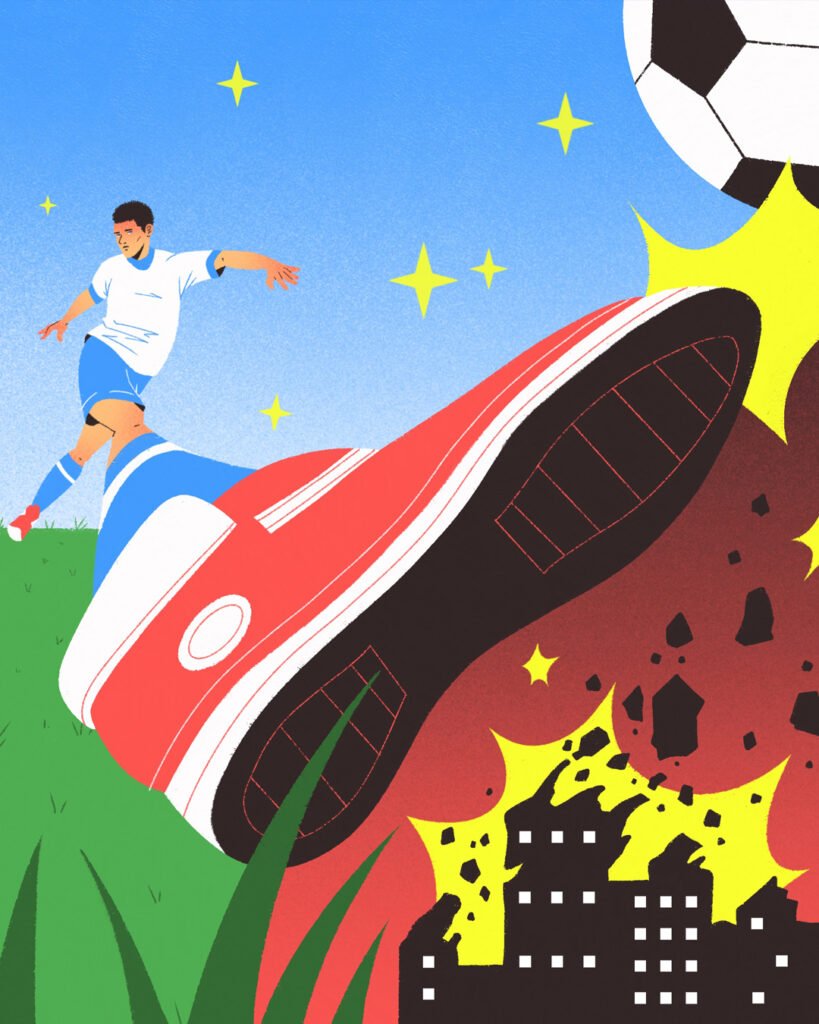 Illustration by @kalakal_klk